Wednesday, March 5, 2014

Life in Patagonia with Lucas


Lucas relaxing in the front garden
It’s been awhile since you heard from us. We haven’t fallen off the face of the earth nor has all of the recent bad press regarding Argentina’s economy made us any less enthusiastic about living here – well, at least for the Northern Hemisphere winters. Sounds as if we missed one of the worst winters on record in the Pittsburgh area.

Inflation is no fun for the locals to endure. At 30% or more per annum, prices in the stores have gone crazy. The government prints more money each month and has put price controls on staple products in the supermarkets. Imports have been greatly reduced to the point that foreign manufactured drugs and medical devices such as artificial hips have become scarce. There is tax of 35% for foreign travel and 20% on foreign purchases charged to credit cards. And yet, through all of the mandated taxes and restrictions the Argentines have remained placid, with a few exceptions of riots and store looting in major industrial cities in December, soldering on with life as usual. They have been through this economic wringer before and surely will do so again with a resilience that is astounding.

A recent editorial in the Buenos Aires Herald is a good nutshell evaluation of recent history:
http://www.buenosairesherald.com/article/153407/a-worldclass-failure

And, for a contrarian’s point of view, the following article is bullish on investing in Argentina:
http://www.caseyresearch.com/cdd/crisis-investing-in-argentina

SO, what’s life like here in our chosen piece of our paradise, San Martin de los Andes (SMA), a town of about 25,000 in the Lake District of northern Patagonia; We hope the following short narrative and numerous photos will give you an idea.

We arise each day to the nearby mountains being progressively swathed by sunlight creeping ever so slowly from mountaintop to the valley below.
Morning sunlight on the Andes with setting full moon
After our morning eye-opener beverage, lemon tea for Diane and Costa Rican coffee for Dick, emails are checked while Lucas has his post-kibble breakfast nap. After about half an hour, his nose is nudging our elbows as it’s time for his morning “walkies” and rabbit hunt during an hour-long walk around the golf course. While walking down the driving range golf balls are booted and tossed with him in full-throttle pursuit; he has mastered picking up 3 balls at a time while in heavy pant mode.

On the driving range


Fresh carrots

Lettuce and arugula
Waiting for gas
Two or three times a week we drive the 25km/15mi to town.  Remember this area is a time warp where there is still a butcher shop and a panaderia/bakery on almost every block. First stop is at the local organic farm where we purchase just-harvested lettuce, arugula, strawberries, spinach, carrots and fresh eggs.

From there we usually try to fuel the car, but owing to the crush of tourists the fuel distribution system is totally incapable of satisfying the demand, hence often looong gas lines.  As a rule of thumb, one fills their tank when the needle goes below the ¾ FULL mark, so the long lines are often a knee-jerk reaction to the possibility of not being able to run on FULL…a circular event causing longer and longer lines.


Lunch overlooking the lake

With shopping done it’s time for lunch, but not before 1 PM and we’ll be the only customers in the restaurant. All local commercial businesses close from 1PM-4 or 5PM for lunch and siesta.  By 2 PM the restaurants are brimming with ebullient diners and we’re hopefully on the way home for our siesta. Fortunately the supermarkets remain open during these hours and are devoid of customers, so shopping in peace is a rare luxury, hence our early lunches.

Our afternoons are spent doing the usual household activities: futzing around in the flower garden doing battle with weeds and the rabbits, reading or otherwise enjoying a glorious day in Patagonia.
Garden path


Each evening, thanks again to Lucas’ insistent nose-nudging reminders, we take another walk or go to the river about 1.25km/1mi from our home. Lucas with head completely submerged and blowing bubbles as he scavenges the riverbed for a stone pitched there for him, comes out with a stone, any one will do, to be deposited on the bank…he has paved a grassy spot with his retrieved stones.

Finding the perfect rock

Depositing said rock
Brilliantly colorful sunsets with a lengthy afterglow are a fine way to segue into wine time as another day in Patagonia is toasted into the record books.


Of course there are great variations on the above themes such as hikes, fishing trips and exploratory drives to more distant towns. There’s a extraordinary private art museum/gallery built by artist Georg Miciu to display works by 3 generations of extremely talented family members. The Georg Collection


An Argentine asado (BBQ)
And there is the constant social whirl with dinners, asados (BBQs), and lunches in one of the many in-town restaurants. We have made so many interesting friends here from all over the world. It seems everyone wants to see us right after our arrival, and then, before we know it we’re entertaining them in preparation for our departure at the end of the summer.
A healthy brown trout
Now in less than a month’s time we’ll be on our way back to Sewickley where we’ll catch up with local friends and prepare for another summer filled with adventures as we take our camper to the Pacific Coast. There will be more to write about for sure.

Monday, March 2, 2009

JUNIN DE LOS ANDES PUESTERO 2009

Each February the gauchos/cowboys of the region meet in Junin de los Andes for what amounts to the annual gathering of the clan, the Calgary Stampede and Macy’s Thanksgiving Parade all in one 4-day event, El Puestero. There is nothing fancy or commercialized about the event, with the exception of all the gauchos decked out in their campo finery. It has the feel of the “old” West and is all about the hard-riding, hard-living gauchos of Patagonia and their horses and horsemanship. Usually of mixed ancestry (Spanish, Portuguese and indigenous Indian), the Patagonian gauchos lived, until modern times, a nomadic life on the fringe of society, often with his horse, saddle and the clothes on his back as his sole possessions. Modern-day gauchos live on large estancias/ranches where they work the cattle and sheep herds over vast tracks of land often spending days or weeks away from home.

A couple of points about the traditional gaucho dress: first, for as rugged as the gauchos are, the common footwear is a rather flimsy, moccasin-like shoes called alparagatas, the Argentine equivalent to espadrilles. As explained to us, since the gaucho spends most of his day in the saddle, with his toes in a strap stirrup there is no need for cowboy boots with their pointed toes and high heel. It seems gauchos spend little time “walking around”. Nest is the boina/beret, often with a very broad brim/visor, for protection from the intense sun, floppy and flexible enough that it does not blow off when riding fast or when faced with the infamous Patagonian winds. Then there are their bombachas/pants with an ample in the seat and gathered at the ankle.The British introduced them adapted from the Turks in the early 1900s. Finally from an early age every gaucho carries a facón, a long knife in an often very gaudy scabbard tucked into a belt in the middle of the back. It was originally intended to settle disagreements or provide personal protection, but now it is a benign adornment unless, of course, you cross a gaucho. No matter, all gauchos put a lot of time and effort into looking the part of the ruggedly handsome, hard-riding nomad of Patagonia, even while he is on his cell phone mounted on his trusted steed!

Our favorite events are the children’s rodeo, where young gauchos-in-training ride and otherwise harass sheep and calves as the youngsters hone their riding and roping skills; the adult rodeo, which is serious business with prize money; and the grand desfile or parade. People line the main street of Junin to view the mounted gauchos with their horses in fine tack, senoritas with wide frilly dresses spread across horses’ backs, a multitude of children’s activity groups (karate, roller skating, gymnastics, etc.) and the various military units from ski troops to mounted gun units (an entire howitzer disassembled and carried on the backs of mules). One of the few mounted bands left in the country, dressed in their red and black Edwardian uniforms complete with polished brass helmets with feather plumes, although it stands as it plays for all the passing groups. And of course, we were treated to all of the local fire trucks, rescue vehicles, trash compactor trucks and even the local taxis and pizza delivery vehicles. There is something for everyone and the townspeople turn out in force to cheer for friends and relatives as they strut their stuff. As far as parades go, it doesn’t get much better when it comes to local enthusiasm and color.

To see more pictures click on Puestero.

DEUX CHEVAUX

Patagonia owing in part to its geographical isolation, more than a 1,000 miles from Buenos Aires, and its relative lack of minerals and arable land has been something of a backwater when it comes to modern fashions or current car models. The Citroën CV2 or deux chevaux vapeur, literally "two steam horses” and its big brother CV3 are still very common in the area. Almost 4 million of these French designed, affordable cars were produced between 1949-1990 at assembly plants around the world including Argentina. The CV2 was the perfect car (on and off the road) for Patagonia with its front-wheel drive, long wheelbase, adjustable road clearance and easily serviceable engine that got incredible mileage 78 km/lt or 184 miles/gal. Many CV2s can still be seen around San Martin. They inevitably bring smiles as we pass them in their various forms preservation or disrepair. To see more pictures click on Deux Chevaux.

ALPARGATAS

Alpargatas were mentioned earlier as the footwear of choice by most gauchos. They are very popular with a lot of others as well. For 13 Argentine pesos or less than $3.75 one can have a very comfortable pair of alpargatas. However Crocs were introduced 2 years ago; move over alparagatas. Everyone who has 64 pesos ($21) to spend on shoes now owns one of more pairs of Crocs. They have become the rage as they have elsewhere in the world. It just took a little longer to reach Patagonia.

SHRINES

Roadside cult shrines are a fairly common sight in Argentina. The two most prevalent are the red flags of Gaucho Gil and the plastic bottles of Difunta Correa.

As legend has it, Gaucho Gil (Antonio Mamerto Gil Núñez) was an army deserter who stole from the rich to give to the poor, a la Robin Hood. He was eventually captured, but was later pardoned by the governor of San Juan Province in 1878. However, the official pardon was not delivered until after he was hung upside down and had his throat slit, as was the custom for army deserters. He is alleged to have said to his executioner, "Your son is very ill. If you pray and beg me to save your child, I promise you that he will live. If not, he will die". The executioner returned home to find his son indeed gravely ill. He left his sick son and built a cross, which he planted at the place of Gaucho Gil’s execution. His son was soon healed. Since then believers in Gil’s divine miracles have visited the execution site and have erected smaller shrines around the country. Offerings of food and strong drink are frequently left in honor of the “gauchito”.

Likewise, the legend of Maria Antonia Deolinda Correa is that she died of thirst in the desert of San Juan Province as she endeavred to give aid to her sick, army conscript husband. Found several days later her child was still suckling milk from his mother’s breast. News of this miracle quickly spread and shrine was erected in the town of Vallecito. At first gauchos, farmers and then trucker drivers erected small shrines around the country leaving license plates, spare parts and water bottles as votive offerings. The cult of Difunta Correa has grown to many hundreds of thousands of believers in this miracle and subsequent miracles attributed to her. Crowds estimated at over 100,000 visit her shrine during the Easter holy week.

The Catholic Church does not recognize either as true saints. One might think since both events took place in San Juan Province that either San Juan is a place where divine miracles do happen or the chamber of commerce devised a way to attract many to an otherwise very desolate area.

Sunday, January 25, 2009

PATAGONIA TRAVELS 2009


Hola amigos...well we’re back in San Martin after a wonderful 10-day trip to the South covering almost 600 miles. Blessed with outstanding weather, bright sun and little wind, we spent two days with friends Trey and Shelby Scharp, Wyoming born and bred, who established a tent camp Sosiego just outside the town of Trevelin. From here we fished the well-known Arroyo Pescado Spring Creek where rainbow and brown trout grow unusually large. Note Diane’s 23” and Trey's 25” rainbows. Nightly fire-cooked dinners outside under a near full moon was icing on the cake.

We then crossed the frontier at Futaleufu and drove down the western slope of the Andes Mountains following the Rio Futaleufu, which is known as one of the finest white water kayaking and rafting rivers in the world. The river stone gravel roads that amount to driving on ball bearings are an ever-present danger for fishtailing into the river ravine. Needlesstosay, the “air brakes” were getting a real workout on the passenger side of the car. Bodhi was oblivious, stretched out across the back seat upside down most of the time.

Our destination was the Martin Pescador Lodge at Puerto Cardenas, Chile. Greeted by long-time friends and lodge owners, Frans and Anna Jansen, we were immediately fed lunch and then sent to the Rio Yelcho for the afternoon’s fishing session. Bodhi accompanied us on sort of a trial trip in a Johnboat. His excitement and our high expectations were soon realized as we started catching fish after the second cast. Bodhi supervised the landing of each fish with a sniff and a gentle mouthing while the fish was in the net. His zeal soon provided our first man overboard drill in the swift current. Grabbed by the scruff of his neck, he was unceremoniously deposited dripping wet in the bottom of the boat. We went back to fishing, and he seemed more mindful of the boat gunwales, however, our minds were made up he would not be joining in any boat excursions for the rest of the week. No skin off his nose as he worked the lodge staff for treats and swims.

The next two days provided the best fishing of our lives with countless large trout many taken on dry flies. Particularly fun was sight casting to fish as they sipped small flies along current seams and foam lines. We had to steel our nerves as we watched fish turn for our flies, open their mouths, and here comes the hard part, when you see the mouth open not to strike/pull the fly away before the mouth closes. Wherever we fished for 2.5 days we caught lovely healthy fish.

As the weather changed to more typical conditions: wind, showers and cooler temperatures, (we had been fishing in shorts) we made the transfer to the Martin Pescador Lodge in La Junta, a two-hour drive down the washboard Carretera Austral, Chile’s Alaskan Highway. For the next three days the Rio Rosselot drainage system would provide our action, which was good but not as spectacular as we had earlier in Pto. Cardenas.

Diane took a day off from fishing to drive to the volcano-ravaged town of Chaiten. In May 2008 the Chaiten volcano that had been dormant for 7,000 years suddenly erupted. Ash spewed over the town disrupting the lives of more than 3,000 inhabitants. The lava flow was negligible but thick ash soon choked the Rio Negro causing a flood that washed through the town putting the final nail in its coffin. The Chilean government ordered the inhabitants to abandon their homes and left only a small detail of soldiers to prevent looting. Local communities absorbed the residents and government provided financial assistance for the displaced families. In recent months the volume of daily ash being blasted into the atmosphere has diminished and large earthmoving equipment has been sent in to try to salvage the town for eventual resettlement.
Fortunately for the region the ash was deposited over a relatively narrow area down wind of the volcano. The aerial photo provides a dramatic view of the ash plume. Remote ranches down wind report the loss of cattle and sheep that could not graze or walk to water owing to the ash deposits.
Diane’s photos will provide a glimpse of the destruction.


We concluded the week with a traditional Chilean asado with a whole fire-roasted lamb, delectable salads and, of course, plenty of fine Chilean wines. Anna, a graduate of the Culinary Institute of America, provided wonderful meals that fitted perfectly with the week’s fishing program designed by Frans. All of this plus 8 other compatible guests made the week the finest lodge stay and finest fishing we have ever enjoyed.

For more pictures of our trip and Chaiten, click on the following links: Fishing in Trevelin and Chile and Chaiten

Sunday, December 28, 2008

CHRISTMAS IN ARGENTINA


Festivities here are a little different from our customs in the States.  It is typical on Christmas Eve (Buena Noche) to have a big asado (BBQ) and roast and entire goat or lamb.  Our hosts cooked a delicious goat served with several cold salads and cakes for dessert all eaten outside. 

Dinner begins at 10:00 PM and at midnight champagne is opened to toast Navidad with hugs and kisses around the table.  Also, at midnight fireworks go off all over town even though they are against the law.  

Our hosts' son is a volunteer fireman, so he stays tuned to his radio.  Around 10 minutes after midnight he gets a call to help put out grass fires, dashing away to the nearby fire station on his bicycle. When he returns, about half an hour later, we go inside for a present exchange.


Christmas Day is spent with friends and family enjoying the leftovers from the the night before. We were invited for 1:30 PM where we enjoyed cold lamb and a large array of cold salads. Another present exchange and then a relaxing time spent in the garden under the trees.  We were home by 6:00 PM and did not need to eat anything else that day.

FISHING WITH BODHI


This morning we went fishing, and I forgot to take the camera.  I could have done a whole study on fishing with Bodhi.  He stands in the water and watches the end of the fishing line waiting for a fish to strike.  If you don't catch something within a few minutes he starts whining with impatience.  If you don't catch anything for a long time he almost howls!  This is our dog who hardly ever barks.  When at last he loses interest, he goes to the bank to pull out roots and sticks.  Of course, he must swim out occasionally to check on things, and that's usually when he swims downstream into the backs of my legs and nearly throws me off balance.  At one point he was watching my line carefully and there was a dragonfly perched on his head.  I would have won a photo contest for that one.  It's tough having your dog criticize your fishing.

WE ARE BACK IN PATAGONIA


We arrived back in San Martin just 2 weeks before Christmas after spending a few nights in Santiago catching up with friends and then a few nights in Villarrica, 400 miles to the south, with more friends.  It was a relief to arrive at our house to find everything in order  This was a big change from last year when construction was still underway.  The landscaping is still a work in progress and if we can beat the rabbits at their game we might get 
the plants to grow.  The introduced European rabbits have now become a plague here so everyone has resorted to rabbit fencing.  The weather has been unseasonably warm with only two rainy days since we arrived.  We still haven't fished as much as we would lik
e to, but now that we are settled there will be more time to do so.  
These house photos should look a little different from the ones we posted last February.

Saturday, February 23, 2008

WHAT IS PATAGONIA

Loosely defined Patagonia is a sparsely populated region stretching sea to sea across the South American Continent south from the 40th parallel to Cape Horn at the tip of South America. It has a land area of 348,000 square miles/561,300 square kilometers, the equivalent size of the states of California and Montana combined (the U.S.’s 3rd and 4th largest states), but with a population of only 2,000,000 inhabitants. Blessed with natural resources of gas, oil, coal, and bauxite, extraction operations have fueled the region’s recent development. Previously sheep and cattle ranching and timber were the staples of its meager economy. While Patagonia has been romanticized as a mysterious land, filled with wide open ranges, snow-capped mountains, smoldering volcanoes, trout-filled rivers and lakes, rugged gauchos and bank robbers like Butch Cassidy and the Sun Dance Kid, it is in fact all of that and more, except the bank robbers have moved to Bolivia. It is also filled with warmhearted people, the best beef in the world and has a mercurial climate of extremes. The rainforests of Chile receive more than 180”/450 cm of rain per year as the lofty Andes peaks wring the moisture from ocean- spawned clouds. To the east the arid Argentine steppes receive less than 15” annual rainfall. Dead still days give way in a matter of minutes to strong winds that can blow ferociously for days on end.

Nomadic Pre-Hispanic tribes settled in the region more than 10,000 years ago. Fernando Magellan made the first contact with the indigenous people in 1502. Disease, displacement, and genocide depopulated the region much the same way as in the American West. The vast steppes produced cattle and sheep barons from the 1850s on all contributing to Argentina’s rise as the world’s fifth wealthiest nation just prior to World War II hostilities. Post War political and economic upheavals and the collapse of the railroads under Dictator Juan Perón in the 1950s left the region an isolated backwater. The discovery of petroleum resources in the 1970s pitched an economic life ring to long suffering towns in Patagonia. Across the Andes, Chile became an economic juggernaut in the 1980s owing to policies put in play by Dictator General Augusto Pinochet. Puerto Montt, Chile’s largest Patagonian town became the world’s largest exporter of farm-raised salmon. The advent of stable democracies and foreign investment has spurred on an economic renaissance and a renewed vitality. Today individuals wanting to escape the confinement and pressures of large cities are heading to Patagonia finding an outstanding quality of life and plenty of room to pursue their entrepreneurial dreams.

For us Patagonia is like returning to the America of our youths with a low density of population, a simple family oriented life, where homes are left unlocked and where the values of honesty and hard work are the accepted norm. For sure Argentina has its own social and economic problems as all nations do, but for us each day is an adventure in an invigorating climate where we can hike in the near-by mountains and wade in crystal clear rivers and kick back by a fire with a glass of fine wine with sizzling meat on the grill in the evening. Falling asleep with the Southern Cross and constellations of bright twinkling stars over head is a nice way to end any day.

Friday, February 22, 2008

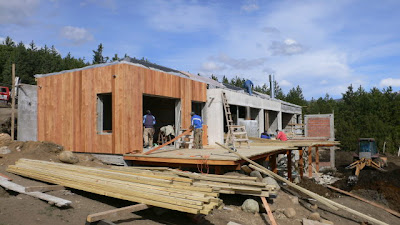
BUILDING A HOUSE IN PATAGONIA....

...takes giant leaps of faith

Building a house anywhere is guaranteed to try one’s mettle. Building in Argentina would be considered by many sheer lunacy…well, we haven’t been committed yet and the fruits of our efforts have exceeded our wildest expectations.

First of all, as the property we chose to buy, while in a well established real estate development, required a year-long approval process that included submitting an FBI report stating we were not felons and that we were not named in any pending lawsuits. Guess Argentina is trying to clean up its image as a nation that harbored war criminals for decades. Anyhow, as it was explained to us, our property was within 50km/30 miles of the international frontiers with Chile, so all foreigners purchasing property had to go through this vetting process to make sure “terrorist” or “undesirable” groups were not sneaking under the radar to establish a secret foothold in Argentina! In reality, the process is one to try the patience of would-be foreign investors.

Being of an impatient sort, we soon learned for every rule there is a way to circumvent it, this is the Argentine way. We did a straw purchase with an Argentine friend, and with the property in her name we preceded full speed ahead to have a house designed and built. The agreements with the architect and the contractor were closed with a handshake and ground was broken without a down payment. To make a long story short, weekly photos were sent via the Internet to keep us apprised of the construction progress and we wired money as certain benchmarks were met.

Really, it was simple a straight forward, much like the way summer houses were constructed in the early 20th century, i.e., plans approved, contractor employed, money sent and your house was ready for the next season. We have nothing but high praise for the seriousness and professionalism showed in accomplishing our objective of moving into a new house before Christmas 2007.

These images will give you a quick tour through the construction process. We're still waiting for the completion of the landscaping.